Skolkovo is changing the Startup Village model: corporations are taking the stage first
28 May 2026
However, there is still a chain of barriers between the ready-made solution and the signed contract, such as procurement procedures, product maturity requirements, long approval cycles, and verification in existing production facilities. The Skolkovo Foundation (VEB.RF Group) acts as an integrator that shortens this chain by converting corporate requests into a format that is understandable to developers, guiding technology companies to pilot projects, and piloting projects to industrial contracts. Startup Village 2026 serves as an entry point into this channelMore than 8000 participants and about 3000 startups will gather at the site; over 2000 targeted business meetings and more than 100 business program sessions are planned.
"For Gazprombank, investments in early-stage projects are part of a systematic effort to create an ecosystem of scientific and technological leadership.Key topics of the business program include industrial artificial intelligence, automation, digital twins, next-generation fintech, cybersecurity, space technologies, and into this channel.
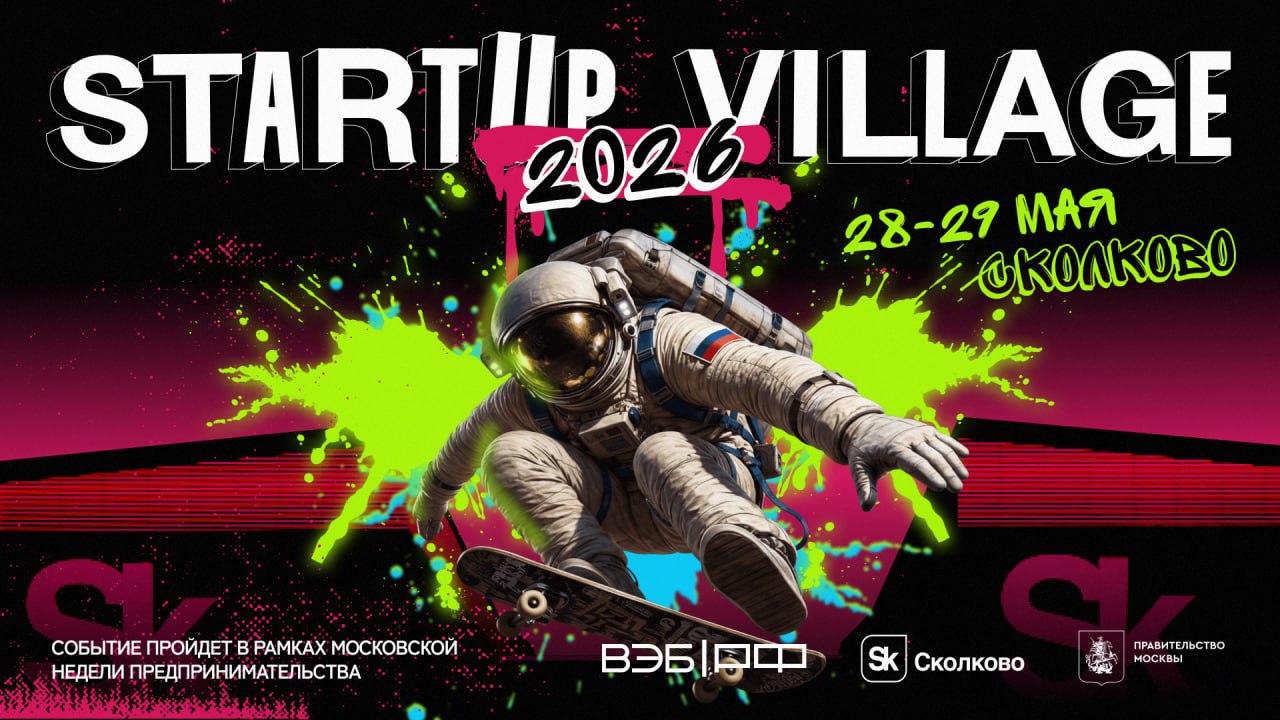
In 2026, for the first time, the event program is based not on ideas and pitches, but on confirmed demand. The largest Russian corporations, partners of the Skolkovo Foundation, including Rostelecom, Gazprombank, Rostec, Rosatom, Roscosmos, Russian Railways, SIBUR, Tatneft, Norilsk Nickel, Severstal, TMK, Softline, and others, are the first to open the platform with specific technological tasks and budgets. Technology companies respond with solutions ready for pilot, implementation, and sale.
The two-day program is built on the logic of reciprocal movement. On the first day, corporations publicly formulate a request — a format in which the customer takes the stage first, which has not existed on the Russian market on such a large scale. On the second day, developers respond with solutions tailored to the specific request. The opening program is set by the session «Technological Orders of the Russian Economy: What Business is Ready to Buy Today,» where representatives of the first wave of corporations outline the priorities for the year.
Six tracks of demand. One main stage of technological leadership.
For the first time, the event’s content architecture is organized not by industry, but by the types of demand that currently shape the Russian technological economy. The program is divided into six tracks, each addressing a specific market demand:
— Demand for products — ready-made solutions that corporations are willing to implement within the next 12 months;
— Demand for new markets — export destinations, import substitution, and access to friendly jurisdictions;
— Demand for science — R&D partnerships between corporations and universities and research centers;
— demand for talent — HR agenda of the tech sector, engineering schools, developer retention;
— demand for a creative agenda — media, design and narrative solutions for packaging, promoting and scaling tech products;
— demand for infrastructure — tech parks, shared use centers, computing power, data.
All six tracks converge on the main stage of the event — the “Tech Leadership Stage”, which formalizes the seventh, synthesizing request: demand for innovation synergy. Here, corporations, the government, science, and technology companies are moving from point-to-point deals to systemic solutions: joint R&D consortia, industry standards, training programs, and infrastructure alliances.
At the Technology Leadership Stage, the Skolkovo Foundation also announces the Demand Index, an annual analytical product that will be released in 2027 and will be the first in Russia to record technologies with confirmed corporate orders based on direct requests from major Russian companies. The index answers the key market question: what is the business really ready to purchase in the next 12-24 months, in which areas the depth of pilots is growing, and where new industry niches and standards are being formed. At Startup Village 2026, the first pilot cut of the results of 2025 will be presented — a working prototype that shows the methodology and logic of the product. For a technology company, this is a market map that allows them to compare their own product with the real corporate demand before starting sales; for an investor and a development institution, it is the basis for technological strategies and the prioritization of support measures for the next year.
More than 8000 participants and about 3000 startups will gather at the site; over 2000 targeted business meetings and more than 100 business program sessions are planned.
«For Gazprombank, investments in early-stage projects are part of a systematic effort to create an ecosystem of scientific and technological leadership. As part of this model, the Bank is not just a customer for individual solutions, but also brings together developers, scientific teams, industrial partners, and development institutions around applied tasks, so that promising technologies can quickly move from the laboratory to production. The new Startup Village format fits well into this logic: corporations openly articulate demand, the market understands the path to pilot and contract, and the track of technological leadership gains another practical dimension,» comments Dmitry Sowers, Deputy Chairman of the Management Board of Gazprombank.
Key topics of the business program include industrial artificial intelligence, automation, digital twins, next-generation fintech, cybersecurity, space technologies, and robotics.