
Skolkovo has signed an agreement to launch Russia’s first pilot AI education program providing continuous artificial intelligence learning for students from grades 1 through 11.
29 May 2026
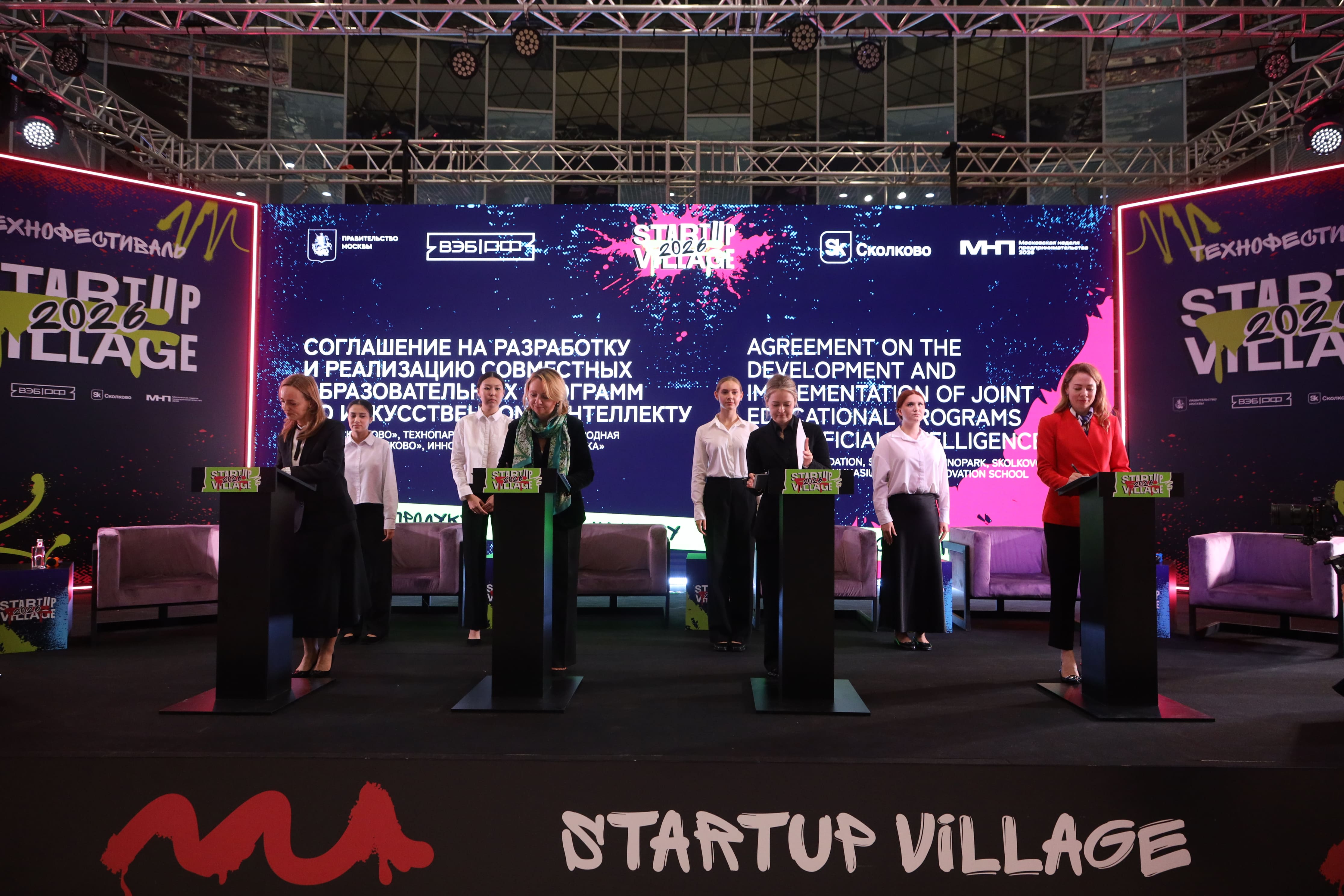
At Startup Village 2026, the Skolkovo Foundation (VEB.RF Group), Skolkovo Technopark, Skolkovo International Gymnasium, and the SKOLKA Innovation School signed an agreement to launch Russia’s first artificial intelligence education program for students from grades 1 through 11.
Starting September 1, 2026, AI classes will become a mandatory part of the curriculum at two pilot schools — Skolkovo International Gymnasium and the SKOLKA Innovation School. Other schools across Russia will be able to use the program’s educational materials free of charge as part of supplementary education programs. The curriculum was developed in partnership with experts from Avito’s technology platform and a leading Chinese university.
Today, the main barrier to AI adoption in the economy is not the technology itself, but people. Most employees begin learning AI tools only in adulthood, without any school or university foundation, which significantly slows the practical implementation of AI in companies. Today’s first-grade students will enter the workforce in the mid-2030s, when artificial intelligence will be embedded in most professional activities. Bridging this gap requires early education, beginning at the stage when fundamental literacy skills are formed.
The “AI Lesson” program follows a gradual immersion approach. In primary school, students learn how artificial intelligence works, how to formulate effective prompts for generative AI systems, how to critically assess AI-generated responses, and how to use digital tools safely. In middle and high school, the curriculum expands to include algorithms, the fundamentals of machine learning, AI ethics, and practical applications of AI in future careers, culminating in project-based learning and career guidance.
The practical phase of the program has already begun. Pilot lessons for students in grades 1–4 were held in May 2026 at Skolkovo International Gymnasium and the SKOLKA Innovation School. The sessions were conducted together with Avito, the program’s partner, whose experts used real-world examples to demonstrate how neural networks work and how they are applied in practice.
Educational materials for grades 1–4 are already available to teachers and parents nationwide, including lesson plans, worksheets, and teaching recommendations. Materials for middle and high school students will be published progressively on the project’s website beginning in September 2026.
Skolkovo Technopark developed the methodology based on international best practices. One of the global leaders in integrating AI into school education is China, where artificial intelligence technologies are being introduced from primary through secondary education under the national AI Plus Education strategy. This experience has been incorporated into the Russian program and adapted to the needs of the national education system.
“We want to equip talented young people with genuine digital literacy: the ability to critically assess information and to see emerging technologies as practical tools for solving real-world challenges — from school projects to pilot solutions for cities and the country as a whole,” said Alexander Chernov, Deputy Chairman of the Board for Public, Social and Educational Policy at the Skolkovo Foundation.
“Introducing children to artificial intelligence should begin as early as possible and should foster not only skills, but also a culture of responsible and conscious technology use. The launch of this school program is part of Skolkovo Technopark’s broader long-term strategy in the field of AI,” said Roman Rusanov, CEO of Skolkovo Technopark.
“We inspire school students to engage with technology. Participation in this project helps children understand how artificial intelligence works in real products and teams, what kinds of problems it solves, and what careers stand behind it. It is important for children to see that behind every major digital product there are real people, real challenges, and a clear pathway into the profession,” said Andrey Rybintsev, Managing Director for Artificial Intelligence at Avito.
“A modern school is not a race to adopt technology; it is about nurturing children’s curiosity. We are not afraid of AI — we are learning to work alongside it, while preserving the right to make mistakes, to dream, and to keep asking ‘why?’,” said Oksana Demyanenko, Principal of Skolkovo International Gymnasium.
“Artificial intelligence is no longer a narrow technological topic; it is becoming a new form of basic literacy. Our task is to make AI understandable and accessible to children from an early age and to help them navigate the AI-driven world consciously and ethically,” said Natalia Kopytova, Principal of the SKOLKA Innovation School.